Blog Article


If you have spent any time evaluating recruiting technology, you have almost certainly weighed the options of whether you need an ATS, a CRM, or both? On the surface, they can look similar as they both store candidate data, both sit inside your TA tech stack, and vendors sometimes use the terms interchangeably. But they are fundamentally different tools built to solve different problems, and choosing the wrong one or skipping one entirely has an impact on how well your team recruits.
This guide breaks down exactly what each system does, where they differ, and how to figure out what your team actually needs.
What Is an ATS System?

An Applicant Tracking System, or ATS, is the operational backbone of your recruiting process. At its core, it is the software that manages everything that happens after a candidate applies for an open role, from the moment a requisition is approved to the moment an offer is accepted.
The ATS was built to solve the specific problem of how you manage a high volume of incoming applications without losing track of where every candidate is in the process. Before ATS systems became standard, recruiting teams were managing spreadsheets, inboxes, and paper files. The ATS replaced all of that with a centralized, structured workflow.
Key Features of an ATS

Job requisition and posting management: Create, approve, and publish open roles across job boards and your careers page from one place
Application collection and parsing: Automatically receive, store, and structure incoming applications and resumes
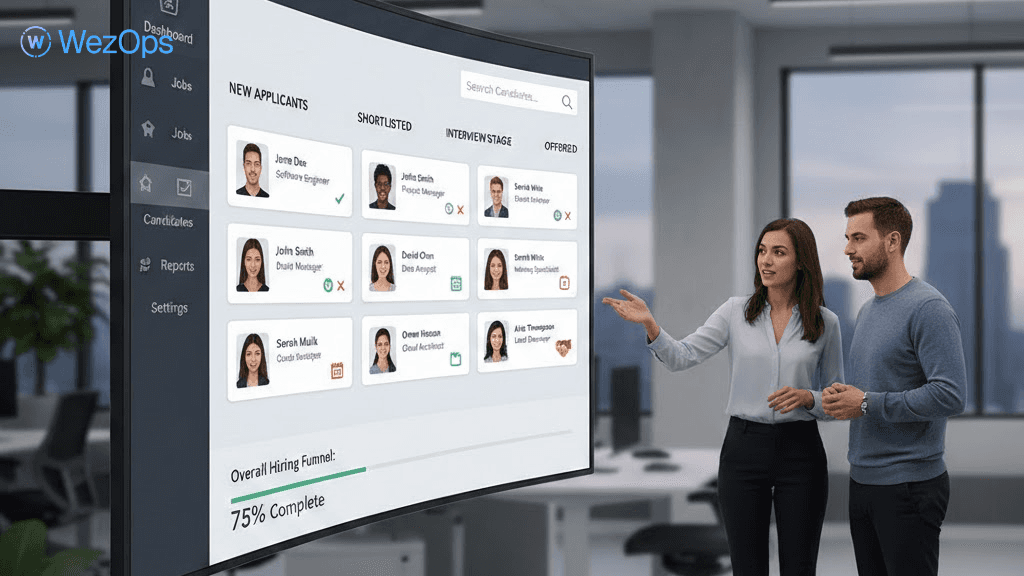
Candidate pipeline tracking: Move candidates through defined stages of screened, interviewed, offered, and hired with full visibility for everyone involved
Interview scheduling and coordination: Sync interviewer calendars, send confirmations, and log feedback in one system
Hiring manager collaboration: Structured scorecards, feedback forms, and approval workflows that keep the whole team aligned
Compliance and data management: Maintain records for EEOC reporting, offer documentation, and audit trails
Offer management and onboarding handoff: Generate and track offer letters, and pass new hire data downstream to HR systems
The ATS is fundamentally a process tool. It keeps active hiring organized, ensures nothing falls through the cracks, and gives TA leaders a clear view of where every open role stands at any given moment.
What Is a Recruiting CRM?

A recruiting CRM which stands for Candidate Relationship Management is the proactive, relationship-building side of your TA tech stack. While an ATS manages candidates who have already applied, a CRM manages the people who have not applied yet, or who applied before and are worth keeping warm for future opportunities.
Think of the CRM as your long-game tool. It is where you build and nurture talent pipelines, engage passive candidates, manage your talent community, and make sure that when a role opens up, you are not starting from scratch. Rather than waiting for applications to come in, the CRM helps your team go out and build relationships with the right people before the vacancy even exists.
Key Candidate Relationship Tools in a CRM

Talent pipeline segmentation: Organize contacts by role type, skill set, geography, or hiring timeline so outreach stays relevant and targeted
Automated candidate nurture campaigns: Send scheduled, personalized emails or messages to keep your talent community engaged over time
Passive candidate sourcing and tracking: Capture profiles from LinkedIn, job boards, events, and referrals into one searchable database
Event and campaign management: Manage career fairs, campus recruiting, and employer brand campaigns with direct pipeline impact
Engagement analytics: Track open rates, response rates, and pipeline conversion to understand what outreach is working
Talent community management: Maintain a living pool of opted-in candidates who want to hear from your organization
Where the ATS is transactional and process-driven, the CRM is relational and proactive. It is the difference between reacting to applications and deliberately building the pipeline you want to draw from.
What's the Difference Between ATS vs. CRM?
Even though ATS and CRM tools often live in the same platform or integrate with each other, they serve meaningfully different purposes. Here is how they compare across the dimensions that matter most:
Focus: An ATS focuses on managing active applicants and filling current open roles while a CRM focuses on building and nurturing candidate relationships for current and future needs.
Scope: The ATS covers the post-application stage, from screening through to offer while the CRM covers the pre-application stage, from first contact and interest through to the point a candidate decides to apply.
Primary benefit: The ATS improves process efficiency, reduces time-to-fill, and keeps hiring organized while the CRM improves pipeline quality, reduces sourcing costs, and builds the employer brand in the candidate market over time.
Best for: The ATS is best for managing reactive, inbound hiring activity while the CRM is best for proactive, outbound talent acquisition, especially for hard-to-fill, specialized, or high-volume anticipated roles.
Does Your Team Need an ATS or a CRM?

For most growing TA teams, the honest answer is that you eventually need both and the question is really about sequence and priority rather than choosing one over the other.
If your team does not have an ATS yet, that is almost always where to start. Without structured process management, your recruiting is built on spreadsheets and inboxes, and no amount of relationship-building will compensate for a broken application and hiring workflow. An ATS is the non-negotiable foundation.
Once your ATS is in place and your core process is running smoothly, the CRM becomes the next meaningful investment, particularly if your team is dealing with any of the following situations:
Consistently struggling to fill specialist or hard-to-find roles.
Your time-to-fill is long.
No structured way to stay in touch with past applicants.
No system to capture and nurture that employer brand interest into an actual talent pool.
In all of these cases, a recruiting CRM directly addresses the gap. It converts one-time interactions into ongoing relationships and turns your sourcing activity into a compounding asset rather than a one-and-done effort.
Research consistently shows that organizations using CRM tools alongside their ATS see measurably shorter time-to-fill and higher quality-of-hire scores because they are drawing from pre-qualified, engaged candidates rather than cold applicant pools.
To Wrap Up
The ATS vs. CRM question is not really about which tool is better but about understanding what each one is built to do and making sure your team has both in place when the time is right.
The ATS keeps your active hiring organized and compliant and the CRM keeps your future hiring pipeline warm and proactive. One manages the process and the other builds the relationship. Used together, they give your TA team the structure and the reach to hire well consistently.
At WezOps, we help talent acquisition teams build the technology infrastructure and operating model that makes tools like ATS and CRM work together effectively, not just as software, but as a connected system.
Book a call with us today!.
FAQs About ATS vs. CRM
What is the difference between an ATS and a CRM in recruiting?
An ATS manages active applicants who have already applied for an open role, tracking them through the hiring process from application to offer while a recruiting CRM manages candidates who have not yet applied, keeping them engaged, organized, and warm so that when a relevant role opens, your team already has a pipeline to work from. The ATS is a process management tool; the CRM is a relationship management tool. Most high-performing TA teams use both in an integrated way.
Can an ATS replace a CRM, or do I need both?
Some modern ATS platforms include basic CRM-like features, such as email sequences or talent community tools, and for smaller teams or simpler hiring needs that may be sufficient. However, a dedicated recruiting CRM offers significantly deeper pipeline segmentation, nurture campaign management, and proactive sourcing capabilities that a standalone ATS typically cannot match.
How should CHROs evaluate whether to invest in a recruiting CRM?
The clearest signal that a CRM investment is warranted is a consistent gap between your sourcing capacity and your hiring demand, particularly if your team regularly struggles to fill specialist roles, has long time-to-fill for specific functions, or is sitting on a large pool of strong past candidates with no structured way to re-engage them. If the answer to any of these is yes, a recruiting CRM is not a must have.
Related Articles