Blog Article

AI adoption in HR surged to 43% in early 2025 and continues accelerating into 2026, but the numbers only tell part of the story. Behind the growth statistics, talent leaders are grappling with a fundamental challenge of rising workloads and shrinking budgets, creating a 12% productivity gap that traditional approaches simply can't bridge. For CHROs and talent acquisition leaders, AI is becoming the difference between scaling operations effectively and drowning in administrative work that keeps teams from strategic priorities.
The Growing Role of AI in HR
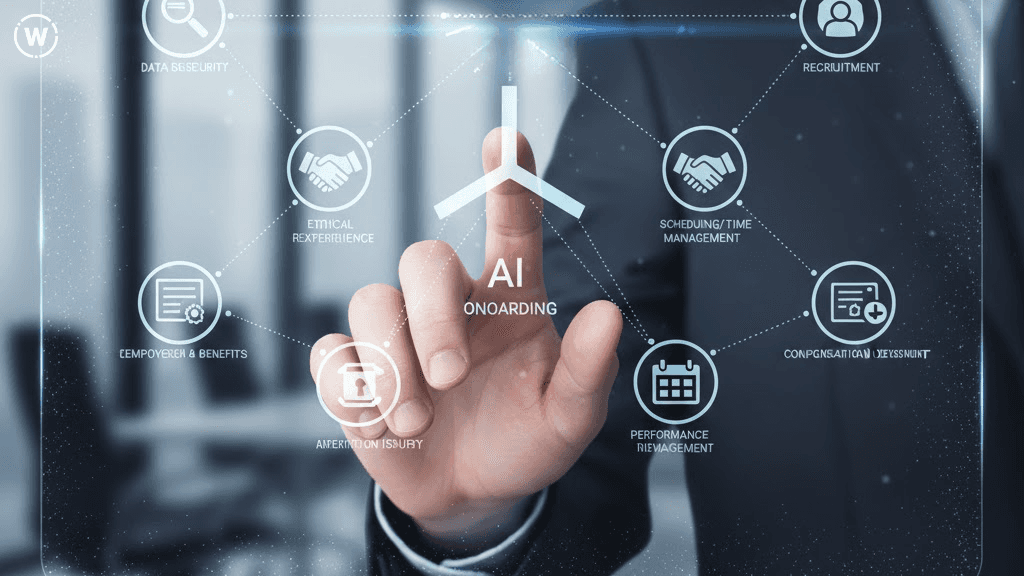
The transformation happening across HR departments goes well beyond automating resume screening or drafting job descriptions. What's changing is how AI tools for HR are reshaping the relationship between people teams and business objectives. Currently, 52% of organizations use AI to write job descriptions, 39% plan to implement it for resume screening, and 48% leverage AI to draft employee communications. These are becoming standard operating procedures that free up HR teams for complex, human-centered work.
The shift is particularly evident in automation in HR operations, where repetitive tasks are systematically handed off to AI while HR professionals redirect attention to strategic workforce planning and employee experience. Research shows organizations using AI to analyze employee skills from performance data boosted overall performance by approximately 25%, but only when paired with strong human oversight.
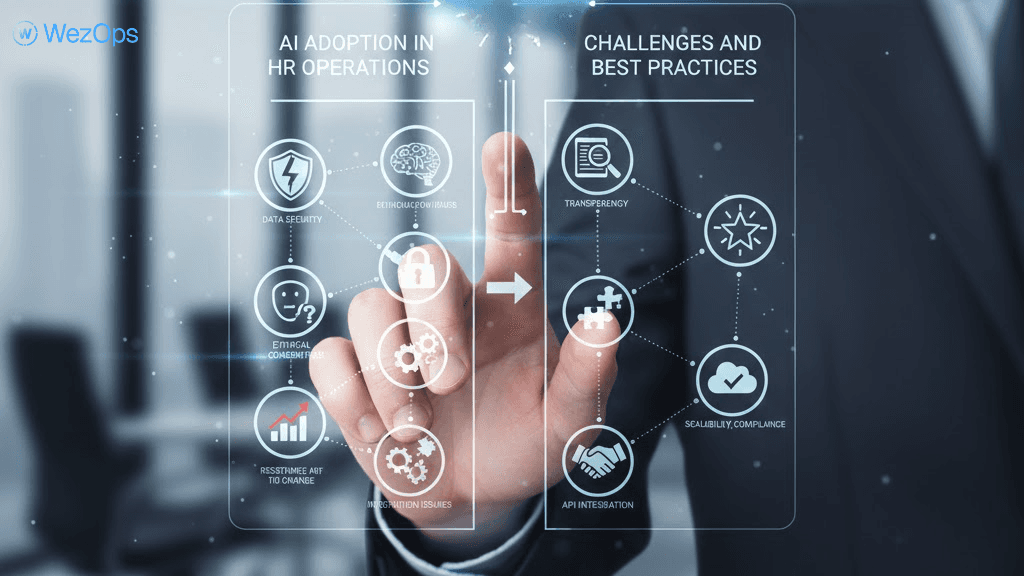
5 Challenges of AI Adoption in HR
1. The AI Skills Gap Within HR Teams
Two-thirds of HR professionals report that their organizations haven't been proactive in training employees to work alongside AI technologies. When teams lack clear guidance on AI's capabilities and limitations, organizations risk underutilizing the technology leading to AI skills gap and resistance to change due to lack of knowledge and this ultimately lead to slow AI adoption.
How to overcome it: Build AI literacy programs specifically for HR contexts, starting with internal teams before scaling organization-wide.
2. AI Tool Overload and Decision Fatigue
The HR technology landscape has exploded with AI solutions, with several options to choose from. HR teams face hundreds of vendors promising to revolutionize everything from recruiting to performance management, yet most lack frameworks to evaluate which tools solve their specific problems. This leads to decision fatigue, fragmented tech stacks, and mounting subscription costs for tools that overlap or sit unused.
How to overcome it: Establish clear evaluation criteria aligned with your top three HR pain points before exploring vendors. Prioritize platforms that integrate with existing systems and start with one well-implemented tool rather than deploying multiple solutions simultaneously.
3. Integration with Existing Systems
The technical friction of connecting AI tools with existing HR tech stacks often derails adoption, particularly where decades-old systems still handle core functions. This is a management change that requires HR to work closely with technology teams without disrupting essential operations.
How to overcome it: Start with standalone AI applications that deliver immediate value without requiring deep system integration, then gradually build connections as you demonstrate ROI.
4. Data Privacy and Algorithmic Bias
HR AI tools process vast amounts of sensitive employee information, raising concerns about ethical storage and usage. AI systems trained on historical data can perpetuate biases, as Amazon's recruiting tool demonstrated when it discriminated against women. Only 27% of organizations have achieved organization-wide AI adoption, with many stalling because they can't resolve questions around bias and compliance.
How to overcome it: Implement regular algorithmic audits with diverse testing datasets, establish clear data governance policies, and maintain human oversight at critical decision points.
5. Loss of Human Connection
As AI handles more candidate interactions and employee queries, organizations risk creating a transactional experience that erodes human relationships at the heart of effective HR. Candidates who only interact with chatbots during recruitment feel less connected to the company, while employees receiving AI-generated feedback may question whether leadership truly understands their contributions. This disconnect becomes particularly damaging during sensitive situations like career development conversations or conflict resolution, where empathy matters more than efficiency.
How to overcome it: Design AI systems to enhance rather than replace human touchpoints. Use AI for high-volume, low-stakes interactions while reserving human engagement for moments that matter most, such as final-round interviews, promotion discussions, and personalized career coaching.
5 Best Practices for AI Adoption in HR
Successfully implementing AI in HR requires balancing technology with human-centered leadership. These practices emerge from organizations achieving measurable, sustained improvements.
1. Start With High-Impact, Low-Risk Use Cases
Begin with clearly defined problems. Identify specific pain points, like the 40-60 hours recruiters spend weekly on resume screening, and implement AI to address that challenge. AI recruitment tools and AI interview tools deliver immediate time savings while allowing HR teams to maintain final decision authority.
2. Build Cross-Functional Governance and Oversight
AI adoption fails when siloed within HR or IT. Leading organizations create cross-functional teams including HR leaders, IT specialists, legal counsel, and business representatives to establish ethical guidelines and monitor outcomes, ensuring AI serves organizational values.
3. Invest in Continuous Learning and Skill Development
Technical skills for working with AI have a two-year half-life. Organizations need continuous learning ecosystems through hands-on experimentation, peer communities, and role-specific development. The evolving role of AI for candidates and TA leaders requires programs addressing both technical competency and strategic implications.
4. Maintain Human Judgment at Critical Decision Points
Effective AI implementations augment rather than replace human decision-making. IBM uses AI to recommend salary increases, but managers make final decisions. Organizations should establish protocols specifying which decisions require human approval and what override mechanisms exist.
5. Communicate Transparently and Often
Regular communication should cover what AI tools are deployed, why they're used, how they affect roles, and what safeguards prevent misuse. Be honest about limitations: AI makes mistakes, algorithms can be biased, and some applications require iteration.
Driving Competitive Advantage With AI in HR

Organizations pulling ahead use AI to solve real problems impacting business performance. When Moderna places IT under the CHRO, it signals that AI's role in workforce management requires HR leadership at the executive level. The competitive edge comes from enabling capabilities that weren't previously possible such as skills-based workforce planning, and predictive analytics that surface patterns to inform policy decisions.
Organizations that treat AI adoption as cultural transformation gain compounding advantages. They develop institutional knowledge, build internal capabilities, thereby reducing vendor dependence, and create feedback loops where successes fund ambitious initiatives.
How to Streamline Your HR Tech
Moving from traditional systems to AI-enabled HR infrastructure doesn't require complete platform replacement to begin delivering value. The most efficient approach focuses on creating interoperability between existing systems and new AI capabilities using APIs and integration layers. Smart organizations audit their current tech stack to identify redundancies and gaps, then prioritize investments addressing critical needs first.
Ready to elevate your HR tech? The team at Wezops specializes in helping organizations navigate HR technology transformation, from strategic planning to implementation, ensuring your AI investments deliver measurable business impact. Contact us today to take the first step toward smarter HR tech.
FAQs
How do I convince leadership to invest in AI for HR when budgets are tight?
Quantify the cost of current inefficiencies in concrete terms such as recruiter hours spent on manual screening, time-to-fill for critical roles, or turnover costs and demonstrate how AI addresses these specific problems with ROI projections based on conservative assumptions.
What's the biggest mistake organizations make when implementing AI in HR?
Deploying AI without changing the underlying processes it's meant to improve. Organizations layer automation onto broken workflows, expecting technology to compensate for poor job descriptions or unclear hiring criteria. AI amplifies whatever processes it touches; if those processes are flawed, you'll execute bad practices more efficiently. The second mistake is insufficient change management and failing to prepare employees for how AI will change their work.
How can we ensure our AI tools don't introduce bias into hiring decisions?
Bias mitigation requires intentional design at every stage such as using diverse training datasets, regularly auditing algorithm outputs for disparate impact, maintaining human review at decision points, and establishing clear processes for candidates to challenge AI-based determinations. Also, work with vendors who can explain their fairness testing methodology and provide transparency into how their algorithms make decisions and note that AI can reduce certain forms of human bias while potentially introducing algorithmic bias, so ongoing monitoring is essential.
Related Articles