Blog Article


One VP of Talent Acquisition cut their time-to-hire by 2-3 weeks by using Lever's new AI interview transcripts and summaries that let hiring teams review recorded interviews in minutes instead of waiting days for feedback. That's the kind of practical impact that makes AI in HR Ops worth attention, not as a futuristic possibility but as an operational reality already happening.
Lever just launched two core features in its Summer 2025 release that address problems talent teams face daily, such as interviewers splitting attention between candidates and note-taking, and TA leaders struggling to prove their team's impact to finance. These aren't experimental add-ons or premium upsells; they're built directly into Lever's core subscription, signalling where the market is heading.
The Core AI Features Launched by Lever
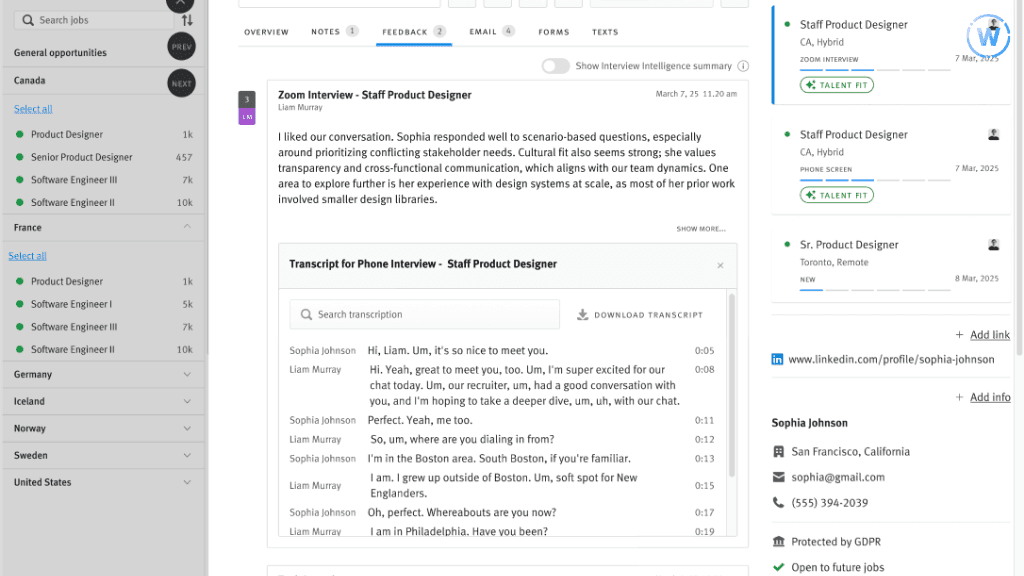
AI Interview Transcripts & Summaries address a tension every interviewer knows: being fully present with candidates while simultaneously capturing detailed notes. Lever's feature automatically records, transcribes, and summarizes every interview, saving everything directly into your ATS, where the entire hiring team can access it.
What that means operationally: Interviewers stop splitting focus between eye contact and note-taking. Feedback gets captured immediately rather than sitting in someone's mental queue for days. Hiring teams see consistent, structured summaries rather than sparse notes from some interviewers and a whole book from others. The result is faster decisions based on better information.
The ROI Dashboard Recommendations tackle a different problem: TA teams generate tons of activity data but struggle to connect it to business outcomes that convince CFOs. Lever's enhanced dashboard now flags specific bottlenecks slowing your hiring funnel, identifies which sourcing channels deliver the strongest candidates versus which waste budget, and benchmarks your performance against similar companies.
This changes AI recruitment tools from "nice to have" to "competitive necessity" because the insights drive concrete actions. When the dashboard shows your interview process has an extra stage that doesn't improve hire quality but adds 2 weeks to every req, you can remove it with data to back the decision. That's the shift from reporting what happened to shaping what happens next.
How Lever Uses AI in Hiring
Lever's implementation reveals principles that work regardless of which ATS platform you use.
First, the features sit inside the workflow people already use rather than requiring separate tools. Interview transcripts are saved directly into Lever, where hiring teams review candidates. The ROI dashboard lives where TA leaders already track metrics. This "built-in, not bolted-on" philosophy matters because adoption rates determine whether tools generate value or gather dust.
Second, the features address specific pain points with measurable outcomes. Interview summaries solve the problem of late or missing feedback, which you can measure by tracking time-from-interview-to-feedback-submitted. ROI recommendations address the challenge of not knowing where your hiring process breaks down, measured by changes in time-to-fill and cost-per-hire after implementing suggested improvements.
Third, and this connects directly to AI fluency in HR, the features augment human judgment rather than replacing it. Interviewers still conduct interviews and make hiring recommendations; they're just freed from administrative note-taking. TA leaders still decide which optimizations to prioritize; they're just armed with better data. This distinction between automation (replacing human work) and augmentation (enhancing human capability) determines whether teams embrace or resist new tools.
The practical implication: start with features that eliminate coordination work and surface better insights, not features promising to "make hiring decisions for you." The former builds trust and demonstrates ROI quickly. The latter creates anxiety and typically underdelivers because hiring requires nuanced judgment that current tools can't replicate.
What the ROI Dashboard Reveals About Modern Talent Operations

Lever's dashboard represents a shift in how talent operations dashboard tools function. Traditional dashboards show what happened: applications, conversion rates, and time-to-fill. Lever's dashboard tells you what to do: "Your interview process has a bottleneck at the hiring manager review stage; candidates wait 8 days here while the team benchmark is 3 days," or "Your employee referral channel delivers candidates who move 40% faster than job board applicants."
This is important for TA leaders trying to elevate their function from order-taker to strategic partner. When you walk into budget discussions with data showing exactly how reallocating $50K from one sourcing channel to another will reduce time-to-fill by 12 days on average, you're having a different conversation than asking for more headcount because "recruiting is hard."
The benchmarking component adds competitive context. Saying "our time-to-hire is 45 days" doesn't mean much without knowing whether that's fast or slow. When the dashboard shows you're at the 65th percentile, faster than 65% of similar companies but slower than the top 35%, you have both validation and a quantified opportunity for improvement.
This connects to the broader challenge with the AI skills gap: most talent teams know they should be "more data-driven" but lack analytical skills to turn data into strategy. Features like Lever's recommendations bridge that gap by doing the analysis and surfacing actionable insights rather than just dumping raw data.
To Wrap Up: The Importance of the Built-In vs. Bolted-On Philosophy
Lever's decision to include these features in core subscriptions signals an important market shift. As tools become table stakes, vendors choose between monetizing every capability individually or bundling features to create broader value propositions.
Lever chose bundling, which benefits buyers in the short term (more capability for the same price) but also reflects a bet about where the market is heading. If interview transcription and ROI insights become expected baseline functionality, like email integration or mobile access, then charging separately would position Lever as behind rather than leading. By making these core features now, they're trying to define the new baseline.
For organizations shopping for ATS platforms, this matters. You're not just comparing feature lists today but betting on which vendors will continue innovating within core platforms versus which will nickel-and-dime you with paid add-ons. The "built-in" philosophy suggests that Lever intends to keep enhancing its core product, which should factor into total cost of ownership over multi-year contracts.
FAQs
How accurate are Lever's AI interview summaries compared to human-written feedback?
Lever's summaries use transcription and natural language processing to capture key discussion points, candidate responses, and interviewer observations. The accuracy depends on audio quality and whether interviewers speak clearly, but early user feedback suggests that summaries capture enough context for hiring teams to make decisions without re-watching entire interviews. The 2-3 week reduction in time-to-hire indicates the summaries provide sufficient signal, though interviewers can still add their own notes for nuance the system might miss.
Do these AI features work for all hiring scenarios?
Lever's interview transcripts work for any role where interviews are recorded via video conferencing tools that integrate with their platform. The ROI dashboard analyzes patterns across your entire hiring data, so it becomes more useful as you have more requisitions and activity to draw insights from. High-volume organizations see faster benefits than companies hiring 1-2 people each quarter, but the features aren't limited by role.
What does "built-in, not bolted-on" mean for organizations already using Lever?
Built-in means these capabilities are included in Lever's core subscription at no additional cost and function as native features within the platform, rather than requiring separate logins or integrations. For existing Lever customers, the features should be available now or rolling out via regular platform updates. For organizations evaluating Lever, built-in means you're getting these capabilities at current pricing rather than facing future upsell conversations.
Related Articles